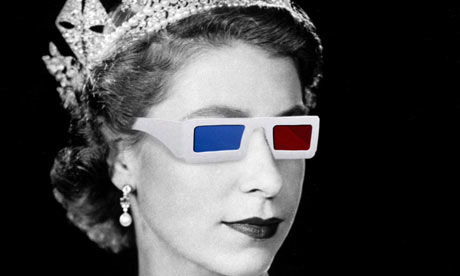
Source from The Guardian
Channel vision
The current 3D week on Channel 4 – which starts with a 50-year-old film – may herald a new age of 3DTV
Tonight you'll get to see the Queen as you've never seen her on television before – in 3D. Even for a non-royalist, that sounds quite fabulously futuristic. But the reality is rather different. Instead of ushering in a new (and much-discussed) age of 3DTV, Channel 4 will actually be drawing on footage that is more than 50 years old.
It was 1953, and the golden era of stereoscopic movies when the young cameramen Bob Angell and Arthur Wooster captured the Queen's coronation in 3D. The first colour 3D feature film had been released a year earlier, and the most fashionable glasses came with red and cyan lenses. For Wooster's 80th birthday this year, his son, David Wooster, the executive producer of the C4 show, rediscovered the old clips.
3D holy grail
The colours have changed for 2009 – C4's glasses, which are free from Sainsbury's, have dark blue and amber lenses to prevent colour loss from the picture – but the technology used is much the same. After enjoying its brief moment in the sun in the 1950s, 3D failed to take off, losing out to the glasses-free experience of 2D broadcasting. Yet the technology is enjoying a new era of hype, exciting broadcasters, retailers and some viewers. C4's Retro 3D Week has attracted criticism in the industry for possibly confusing the audience. Yet it serves to focus attention on 3D and its place in the industry's future. Will it take off?
The new stereoscopic TV should hit the UK at the end of next year, with Sky promising a new 3D service, and manufacturers unveiling 3D-ready screens. Mass-market 3DTV without the need for special eyewear is the holy grail.
Sky points to the success of HD as evidence that it could become mainstream. "It's really difficult to forecast [take-up of 3D]. Many people said that HD would be niche, that it really wouldn't be mainstream, and here we are with 1.6m homes with an Sky+ HD box in them," says Brian Lenz, director of product design and TV product development at BSkyB. The broadcaster has already tested its 3D technology on ballet, cricket, golf and music content, as well as Gladiators, and has plans to expand into drama.
But will consumers be prepared to buy a 3D set so soon after purchasing new HD models? "3D-ready televisions will launch at a premium price, but so did HDTVs when they came to the market, and over time pricing will be more and more competitive," says Lenz.
From a retail perspective, John Lewis says it is too early to say to what extent it will be stocking 3D televisions. John Kempner, the company's central buyer, vision, says: "HD technology is really selling extremely well. We have seen huge growth in sales of Blu-ray players (as they become much more affordable), freesat TVs, and set-top boxes (including digital recorders) have also proved big sellers as customers want to see the benefits of viewing high-definition content on their TVs."
While it took around 20 years to develop a standard HD and bring it to market, analysts believe 3D will move much more quickly, especially now that Hollywood is interested. This year 15 3D films will be released in cinemas, more than in any other year, including Disney's A Christmas Carol and Up, and Fox's sci-fi epic from James Cameron, Avatar. All-important DVD sales of 3D films depend on the home market catching up. An industry standard for 3D has yet have arrived, but neither Hollywood nor manufacturers want to see a repeat of the destructive HD DVD/Blu-ray wars that accompanied the arrival of HD.
A more likely source of conflict is delivery of 3DTV. Sky is pressing ahead with premium 3D delivered through existing HD boxes on a dedicated channel for those who have purchased 3D sets. Other people, however, would like to see a more gradual roll-out of 3D that more closely replicates the move from black and white to colour TV than the move to HD, with programmes gradually being broadcast simultaneously in both 2D and 3D.
Gaming push
This will allow audience choice but it will also take longer. Sky is setting the pace among broadcasters for its fast move into 3D – despite the BBC being first in the UK to broadcast a full international sporting event live in 3D when its Six Nations coverage was relayed to a cinema audience last year.
"At the moment it is too early for the corporation to have a 3DTV strategy as there is not yet a clear route to audiences," says a BBC spokesman. What that means is that there is currently no standard for 3D broadcast, or rules for how set-top boxes will work with 3D televisions. While Sky owns all its boxes, if the BBC started broadcasting in 3D tomorrow, most viewers wouldn't be able to see it.
So how long before that problem is likely to be fixed? "I think it's too early to say," says Graham Thomas, principal research engineer in the BBC's research and development department. "It's really unclear at the moment what the take-up of 3D will be." Will it be another flash in the pan as it was in the 50s? "We're really watching how 3D evolves." There are plans to film some of the Olympics in 3D – but that could be for archive purposes rather than broadcast.
Some broadcasters believe 3DTV will only reach a wide audience when we can ditch the goggles and are waiting for that moment – although Philips, which was manufacturing an autostereoscopic (or glasses-free) television, has since halted production. "The point in time where mass adoption of no-glasses based 3D TV will occur has shifted significantly," says Philips's director of communications, Björn Teuwsen, without saying where it has shifted to.
In fact, the big push to 3D could come not through broadcasters, but via the gaming industry, with graphics easier to render in 3D than television pictures. "The more 3D games are delivered, as soon as you get enough of those screens going into the home, then theoretically they'll be able to download and watch movies and TV shows in 3D," says David Wooster.
Related Links:
Channel 4 - 3D Week website

沒有留言:
張貼留言