Powered by FxFactory; Stereo3D Toolbox is a plug-in designed to work with Adobe® After Effects® CS3 / CS4, Apple® Final Cut Pro®, Apple® Motion® and Apple Final Cut® Express applications. With Stereo3D Toolbox, artists can easily output their media to a wide range of Stereoscopic 3D formats (side by side, over/under, checkerboard, interlace, anaglyph) as well as manage the demuxing of side by side, interlace and over/under formatting. Comprehensive compositing features and capabilities include keyframeable x, y, z axis convergence, individual left/right eye scale, color correction, selective flip/flop, reframing and “auto scale” compensation.
YouTube test a stereoscopic player for watching videos in 3D. If you go to this video, you'll notice a drop-down that includes some options for red/cyan and amber/blue 3D glasses and some options that don't require glasses.
"Stereoscopy, stereoscopic imaging or 3-D (three-dimensional) imaging is any technique capable of recording three-dimensional visual information or creating the illusion of depth in an image. The illusion of depth in a photograph, movie, or other two-dimensional image is created by presenting a slightly different image to each eye," explains Wikipedia.
NOVAK 3D DISCO are the originators of the fully audio visual 3D club experience. It is s world first established since 2006. Our shows have been performed at Glastonbury Festival, with Calvin Harris and Chemical Brothers in Trafalgar Square, Kraftwerk in Bucharest, across the world and in dozens of student unions and clubs.
Keiichiro Shibuya is born in Tokyo in 1973. He graduated with a degree in composition from Tokyo National University of Fine Arts and Music. In 2002, he established Atak, which functions not only as a music label, releasing CDs of domestic and overseas cutting-edge electroacoustic works, but also embraces creators in various fields such as design, network technology and so on, as well as being a kind of platform to develop dynamic new work. Later in 2002, Shibuya was involved in the commenmoration CD of founding of Mori Art Museum. In 2003, he released a CD Keiichiro Shibuya + Yuji Takahashi (ATAK002) in collaboration with Yuji Takahashi, a Japanese composer/pianist. Later in 2003 Atak made a domestic concert tour with Icelandic Stilluppsteypa. In 2004, he released his first solo album Keiichiro Shibuya (ATAK000). His dense composition in that he drastically focused in sound material(color) and rhythm, was described as “a perfect work that rules over the history of electronic music” (Sasaki Atsushi).
Shibuya has been continuing collaboration with Takahashi Yuji (composer/pianist), Ikegami Takashi (complex system researcher/associate professor at Tokyo University) and Fujihata Masaki (media artist/professor at Tokyo National Unicersity of Fine Arts and Music). In 2005 Shibuya and Ikegami started their collaboration as they exhibited a sound installation work at ICC (NTT Intercommunication Center, Tokyo Oprera City) and made a concert-style presentation to unveil the The Third Term Music - a music theory of sound variation and the motion dynamics based on nonlinear sciences. His latest album Filmachine Phonics and installation work with Ikegami Takashi - Filmachine, were awarded honorary mention in the digital music division at Ars Electronica in 2007. Currently, he works for a pedestrian crossing signal music project as an electroacoustic specialist as well as working as a musician International Association of Traffic and Safety Sciences; for the project he composes music from the viewpoint of urban design in place of the previously-used melody Toryanse.
Currently, he works as an adjunct professor at the Tokyo National University of Fine Arts and Music.
Christian Fennesz (born 25 December 1962) is an Austrian electronic musician, often credited on albums simply as Fennesz.
A key figure in the ascent of IDM and electronica in the 1990s, Fennesz uses guitar and notebook computers to make multilayered compositions that blend melody and conventional musical instruments with harsh, irregular glitch-influenced sounds and washes of white noise. He lives and works in Vienna, Austria and Paris, France.
Fennesz was born and raised in Austria and studied music formally in art school. He started playing guitar around the ages 8 or 9.In the late 1980s, he formed a band called Maische, with a 'noise meets pop' approach similar to bands such as Sonic Youth and My Bloody Valentine. Maische found some local popularity, but Fennesz was uncomfortable with the band setup and left. Afterwards, he became involved in the Viennese techno scene of the early 1990s. From there on, he began to collect his own equipment and produce music based loosely around guitar and synthesizer sounds.
Since the 1990s, Fennesz played live with Ryuichi Sakamoto, with British electroacoustic improvisation icon Keith Rowe, and with quirky American pop group Sparklehorse. He has also worked alongside Peter Rehberg and Jim O'Rourke in the improvisional trio Fenn O'Berg, and with British singer David Sylvian - Sylvian sang on Fennesz's album Venice while Fennesz composed the music for "A Fire in the Forest" from Sylvian's album Blemish and made contributions to Sylvian's "When Loud Weather Buffeted Naoshima". Fennesz also remixed Ulver on the album 1993-2003: First Decade in the Machines, as well as appearing on their 2007 album Shadows of the Sun.
Fennesz had ties with the Vienna-based label Mego, and is now signed to Touch in the UK. Fennesz and Sakamoto released a collaborative album entitled Cendre in March 2007 on Sakamoto's new Commmons label, via Touch. Fennesz performed with singer Mike Patton at the 2007 Moers Festival - marking the first time the two have performed together on stage in Europe, as they have performed in 2006 at the Festival International de Musique Actuel de Victoriaville, and will continue to tour Europe together into June.
Ryoichi Kurokawa is a japanese audiovisual artist. His works take on multiple forms such as screening works, recordings, installation and live performance. Kurokawa composes time based sculpture with digital generated materials and field recorded sources, and the minimal and the complexities coexist there. Kurokawa accepts sound and imagery as a unit not as separately, and constructs very exquisite and precise computer based works with the audiovisual language. That shortens mutual distance, the reciprocity and the synchronization of sound and visual composition. He also performed live-visual for musicians such as HUMAN AUDIO SPONGE(ex.YMO: Sketch Show + Ryuichi Sakamoto). In recent years, Kurokawa is invited to numerous noted international festivals and museums in Europe, US and Asia including TATE MODERN[UK], ARS ELECTRONICA[AT], transmediale[DE], Shanghai eARTS[CN], MUTEK[CA], TodaysArt[NL] and SONAR[ES] for exhibition, screening or audiovisual concert, and he continues to be an active presence on the international stage."
Ryoji Ikeda (born 1966 in Gifu, Japan) is a Japanese sound artist who lives and works in New York City. Sometimes harsh, sometimes remarkably gentle, Ikeda's music is concerned primarily with sound in a variety of "raw" states, such as sine tones and noise, often using frequencies at the edges of the range of human hearing. The conclusion of his album +/- features just such a tone; of it, Ikeda says "a high frequency sound is used that the listener becomes aware of only upon its disappearance" (from the CD booklet). Rhythmically, Ikeda's music is highly imaginative, exploiting beat patterns and, at times, using a variety of discrete tones and noise to create the semblance of a drum machine. His work also encroaches on the world of ambient music; many tracks on his albums are concerned with slowly evolving soundscapes, with little or no sense of pulse.
In addition to working as a solo artist, he has also collaborated with, among others, Carsten Nicolai (under the name "Cyclo.") and the art collective Dumb Type. His work matrix won the Golden Nica Award in 2001.
In 2004, the dormant Saarinen-designed TWA Flight Center (now Jetblue Terminal 5) at JFK Airport briefly hosted an art exhibition called Terminal 5 curated by Rachel K. Ward and featuring the work of 18 artists including Ryoji Ikeda. The show featured work, lectures and temporary installations drawing inspiration from the idea of travel — and the terminal's architecture. The show was to run from October 1, 2004 to January 31, 2005 — though it closed abruptly after the building itself was vandalized during the opening party.
AntiVJ is a visual label initiated by European-based artists whose work is focused on the use of projected light and its influence on our perception. Clearly stepping away from standard setups & techniques, AntiVJ presents live performances and installations where projection on volume, visual mapping, tracking and augmented reality, stereoscopy and holographic illusion are providing to the audience a senses challenging experience.
United Visual Artists are a British-based collective whose current practice spans permanent architectural installation, live performance and responsive installation. Research and development is a core part of our process - enabling us to constantly explore new fields, as well as re-examining more established ones.UVA aims to work on a diverse and expanding range of projects, drawn from the commercial and non-commercial arenas, and to collaborate with a wide range of artists and companies.
Alva Noto is the pseudonym of German audio-visual artist Carsten Nicolai; techno producer, video and installation artist, event organizer and manager of the renowned Raster-noton imprint. Nicolai founded the label noton.archiv für ton und nichtton before joining forces with Raster Music in the late 90s. Nicolai also operates under the aliases Noto and Aleph-1, and is a member of the groups Signal (with Frank Bretschneider and Olaf Bender) and Cyclo. (with Ryoji Ikeda). He is also well known for his early 00s collaborations with Ryuichi Sakamoto, ‘Vrioon’, ‘Insen’ and ‘Revep’.
Carsten Nicolai was born in Chemnitz, in 1965. After studying architecture and landscape design, he developed an interest in the theoretical properties of sound and space, and began experimenting with electronic music. In the mid 90s, Nicolai founded an experimental music label, 'noton.archiv für ton und nichtton', as a platform for his conceptual sound experiments, and in 1996 began working with the moniker Noto. His first album was ‘Spin’ (1996). Nicolai was fairly prolific through the late 90s and early 00s with production and exhibitions.
Raster-Noton was created in 1999 from the merger of 'noton.archiv für ton und nichtton' and Rastermusic, founded by Olaf Bender and Frank Bretschneider, also in Chemnitz. A 1996 idea for a conceptual cd magazine was finally realised as the 20`to 2000 series on Raster-Noton between 1999 and 2000, making the label famous internationally.
Nicolai’s first solo album as Alva Noto was 2000's Prototypes on Mille Plateaux, a ten-track, 50-minute album of untitled sound collages using precisely arranged electrical hums and clicks. Transform followed the next year, developing the style that would soon be dubbed glitch or click and cuts. The aesthetics of Nicolai’s world have a lot in common with a science laboratory – clean lines and precisely calculated tangents. Many of his works have a direct link with the natural sciences, particularly his installation works employing video, sound, light and processes such as ice-formation, with titles such as “Crystalline Beauty in Mathematical Space.”
Nicolai’s release on Richard Chartier's LINE imprint, For (2006), revealed a more organic, personal approach, leaving the conceptual frameworks in the background; it’s an album of nine compositions connected only by their presentation as audio installations and their existence as personal dedications.
More recent Alva Noto productions, xerrox and Unitxt (2008) have seen a further broadening of Nicolai’s stark and at times ascetic mandate. For Xerrox, the name and subject matter are taken from the original Xerox machine: the compressions, multiplications, scale changes and shifts in resolution. While previous Alva Noto releases rarely used sound sources external to the computer, xerrox features a collection of (processed) found sounds; Noto works with samples from muzak, advertising, soundtracks and entertainment programs, including samples from these sources: Narita airport Tokyo, in-flight program Air France, telephone wait-loop Lufthansa, hotel Apollo Paris, Suizanso hotel Yamaguchi, Seven-Eleven Tokyo, Forma London. The sounds are manipulated into unrecognizability through repeatedly degraded copies.
Unitxt (2008) signaled an increase in musicality and muscularity. The album featured poet Anne-James Chaton reading ephemera extracted from Nicolai’s wallet in a collision of deep precision and identity flotsam. Nicolai performed a live set based around Unitxt at Berlin’s biggest techno club, Berghain, in mid 2008.
Nicolai has performed and exhibited in many of the world’s most prestigious art spaces, including The Guggenheim NYC, documenta x and the 49th and 50th Venice Biennale, He’s had two comprehensive solo exhibitions at Schirn Kunsthalle Frankfurt, Germany (anti reflex) and at Neue National Galerie in Berlin, Germany (syn chron) in 2005, as well as Watarium in Tokyo.
Channel vision The current 3D week on Channel 4 – which starts with a 50-year-old film – may herald a new age of 3DTV
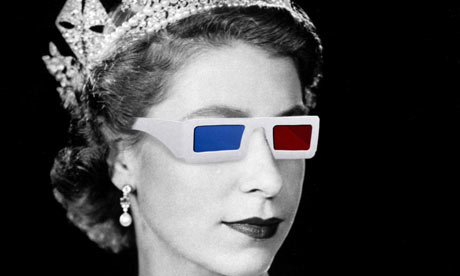
Tonight you'll get to see the Queen as you've never seen her on television before – in 3D. Even for a non-royalist, that sounds quite fabulously futuristic. But the reality is rather different. Instead of ushering in a new (and much-discussed) age of 3DTV, Channel 4 will actually be drawing on footage that is more than 50 years old.
It was 1953, and the golden era of stereoscopic movies when the young cameramen Bob Angell and Arthur Wooster captured the Queen's coronation in 3D. The first colour 3D feature film had been released a year earlier, and the most fashionable glasses came with red and cyan lenses. For Wooster's 80th birthday this year, his son, David Wooster, the executive producer of the C4 show, rediscovered the old clips.
3D holy grail
The colours have changed for 2009 – C4's glasses, which are free from Sainsbury's, have dark blue and amber lenses to prevent colour loss from the picture – but the technology used is much the same. After enjoying its brief moment in the sun in the 1950s, 3D failed to take off, losing out to the glasses-free experience of 2D broadcasting. Yet the technology is enjoying a new era of hype, exciting broadcasters, retailers and some viewers. C4's Retro 3D Week has attracted criticism in the industry for possibly confusing the audience. Yet it serves to focus attention on 3D and its place in the industry's future. Will it take off?
The new stereoscopic TV should hit the UK at the end of next year, with Sky promising a new 3D service, and manufacturers unveiling 3D-ready screens. Mass-market 3DTV without the need for special eyewear is the holy grail.
Sky points to the success of HD as evidence that it could become mainstream. "It's really difficult to forecast [take-up of 3D]. Many people said that HD would be niche, that it really wouldn't be mainstream, and here we are with 1.6m homes with an Sky+ HD box in them," says Brian Lenz, director of product design and TV product development at BSkyB. The broadcaster has already tested its 3D technology on ballet, cricket, golf and music content, as well as Gladiators, and has plans to expand into drama.
But will consumers be prepared to buy a 3D set so soon after purchasing new HD models? "3D-ready televisions will launch at a premium price, but so did HDTVs when they came to the market, and over time pricing will be more and more competitive," says Lenz.
From a retail perspective, John Lewis says it is too early to say to what extent it will be stocking 3D televisions. John Kempner, the company's central buyer, vision, says: "HD technology is really selling extremely well. We have seen huge growth in sales of Blu-ray players (as they become much more affordable), freesat TVs, and set-top boxes (including digital recorders) have also proved big sellers as customers want to see the benefits of viewing high-definition content on their TVs."
While it took around 20 years to develop a standard HD and bring it to market, analysts believe 3D will move much more quickly, especially now that Hollywood is interested. This year 15 3D films will be released in cinemas, more than in any other year, including Disney's A Christmas Carol and Up, and Fox's sci-fi epic from James Cameron, Avatar. All-important DVD sales of 3D films depend on the home market catching up. An industry standard for 3D has yet have arrived, but neither Hollywood nor manufacturers want to see a repeat of the destructive HD DVD/Blu-ray wars that accompanied the arrival of HD.
A more likely source of conflict is delivery of 3DTV. Sky is pressing ahead with premium 3D delivered through existing HD boxes on a dedicated channel for those who have purchased 3D sets. Other people, however, would like to see a more gradual roll-out of 3D that more closely replicates the move from black and white to colour TV than the move to HD, with programmes gradually being broadcast simultaneously in both 2D and 3D.
Gaming push
This will allow audience choice but it will also take longer. Sky is setting the pace among broadcasters for its fast move into 3D – despite the BBC being first in the UK to broadcast a full international sporting event live in 3D when its Six Nations coverage was relayed to a cinema audience last year.
"At the moment it is too early for the corporation to have a 3DTV strategy as there is not yet a clear route to audiences," says a BBC spokesman. What that means is that there is currently no standard for 3D broadcast, or rules for how set-top boxes will work with 3D televisions. While Sky owns all its boxes, if the BBC started broadcasting in 3D tomorrow, most viewers wouldn't be able to see it.
So how long before that problem is likely to be fixed? "I think it's too early to say," says Graham Thomas, principal research engineer in the BBC's research and development department. "It's really unclear at the moment what the take-up of 3D will be." Will it be another flash in the pan as it was in the 50s? "We're really watching how 3D evolves." There are plans to film some of the Olympics in 3D – but that could be for archive purposes rather than broadcast.
Some broadcasters believe 3DTV will only reach a wide audience when we can ditch the goggles and are waiting for that moment – although Philips, which was manufacturing an autostereoscopic (or glasses-free) television, has since halted production. "The point in time where mass adoption of no-glasses based 3D TV will occur has shifted significantly," says Philips's director of communications, Björn Teuwsen, without saying where it has shifted to.
In fact, the big push to 3D could come not through broadcasters, but via the gaming industry, with graphics easier to render in 3D than television pictures. "The more 3D games are delivered, as soon as you get enough of those screens going into the home, then theoretically they'll be able to download and watch movies and TV shows in 3D," says David Wooster.